Two miles sounds simple on paper. But the reality? It stretches or shrinks depending on how you move through it. Whether you’re driving through rush hour traffic, walking a neighborhood loop, or running a fitness challenge, this distance transforms completely.
Most people underestimate what 2 miles actually means in time and effort. A quick highway stretch takes barely 2 minutes. A leisurely walk? That’s a full 40-minute commitment. The gap between these experiences is massive, and understanding it helps you plan better, train smarter, and navigate daily life with confidence.
How Long is 2 Miles?
Two miles equals 10,560 feet in the imperial system. In metric terms, that’s 3,218.7 meters or 3.22 kilometers. For those counting yards, you’re looking at exactly 3,520 yards. These conversions matter when you’re comparing distances across different measurement systems.
But raw numbers don’t tell the full story. Context changes everything. Two miles on a standard running track means 8 complete laps. On an American football field, you’d circle the perimeter roughly 10 times. The same distance feels entirely different depending on where and how you experience it.
How Long Does 2 Miles Take? (By Different Methods)
Time varies dramatically depending on your mode of travel, fitness, terrain, and conditions. Here are realistic estimates for covering 2 miles.
Highway Driving
~2 minutes
Average speed: 60 mph
Minimal traffic, clear roads, no stops
City Driving
4–8 minutes
Average speed: 20–30 mph
Traffic lights, congestion, stops
Casual Walking
30–40 minutes
Average speed: 3–4 mph
Flat terrain, steady pace
Jogging / Running
15–20 minutes
Average speed: 6–8 mph
Moderate fitness level
Cycling (Recreational)
8–10 minutes
Average speed: 12–15 mph
Relaxed riding pace, flat roads
Swimming (Freestyle)
30–40+ minutes
Rough equivalent: ~64 Olympic pool lengths
Depends heavily on skill & endurance
From a quick 2-minute drive to a solid 30–40 minute walk or swim — the same 2 miles can feel like a completely different experience depending on how you travel!
What Does 2 Miles Look Like?

Numbers alone don’t create understanding. You need visual anchors to truly grasp what 2 miles means in the physical world. These comparisons make the distance tangible and memorable.
The average American walks about 3,000 to 4,000 steps per mile. That means 2 miles translates to roughly 6,000 to 8,000 steps, depending on your stride length and walking style.
Famous Landmarks & Locations
The National Mall in Washington, D.C. stretches about 2 miles from the U.S. Capitol Building to the Lincoln Memorial. This iconic stretch has hosted historic presidential inaugurations and massive public gatherings that drew over a million people.
Manhattan’s Central Park measures 2.5 miles north to south. Two miles covers about 80% of that length. You’d pass Belvedere Castle, The Great Lawn, and the Metropolitan Museum of Art area while walking this distance through the park.
The Sunshine Skyway Bridge near Tampa, Florida spans 4.14 miles total. At the halfway point, you’ve traveled exactly 2 miles while suspended over Tampa Bay. This cable-stayed bridge rises 430 feet above the water at its peak.
Sports & Athletic Comparisons
For track athletes, 2 miles means 8 complete laps around a standard 400-meter track. This distance is a common military fitness test benchmark used to measure cardiovascular endurance.
An American football field including both end zones measures 120 yards long and 53.3 yards wide. The full perimeter is approximately 346 yards. To cover 2 miles, you’d need to circle the field roughly 10 times.
A regulation soccer field typically measures 360 feet by 225 feet with a perimeter around 1,170 feet. Two miles equals about 9 complete laps around this field. Professional soccer players often cover 7 miles or more during a single 90-minute match.
In an Olympic-sized swimming pool (50 meters long), 2 miles requires 64 pool lengths or 32 complete laps down and back. Elite swimmers train at this distance regularly to build aerobic capacity and muscular endurance.
If you ran 32 consecutive 100-meter dashes at sprint pace, you’d cover exactly 2 miles. However, maintaining true sprint speed for this distance is physiologically impossible for most athletes.
How Long Does 2 Miles Really Take When Driving?

Driving time for 2 miles depends heavily on road type and conditions. The difference between highway and city driving is enormous when measuring actual travel time.
Traffic data shows that average urban speeds range from 15-35 mph during peak hours. This variability directly impacts your 2-mile commute time.
Highway vs City vs Suburban Driving
On interstate highways with posted limits of 60-70 mph, 2 miles passes in approximately 2 minutes under ideal conditions. There are no traffic signals, minimal exits, and consistent flow patterns. This represents the fastest possible road travel scenario.
Suburban roads with 35-40 mph limits typically require 3-5 minutes for 2 miles. You’ll encounter occasional traffic lights, school zones, and residential areas with lower speed enforcement. Stop-and-go patterns add unpredictable delays.
City center driving transforms completely. With downtown traffic, pedestrian crossings, delivery trucks, and frequent signals, 2 miles can stretch to 6-12 minutes or longer. Rush hour conditions multiply these delays significantly.
What Affects Your 2-Mile Drive Time?
Traffic congestion ranks as the primary delay factor in urban areas. Drivers in major U.S. cities lose 50-100 hours annually to congestion, dramatically extending short trips.
Weather conditions impact both speed and safety. Rain reduces visibility and creates hazardous road surfaces. Snow and ice can cut safe driving speeds in half. Fog demands even slower, more cautious travel.
Construction zones force detours and lane reductions. These temporary obstacles can double or triple your expected travel time for familiar routes. Posted work zone limits drop to 25 mph or lower in many areas.
How Long Does 2 Miles Take Walking or Running?
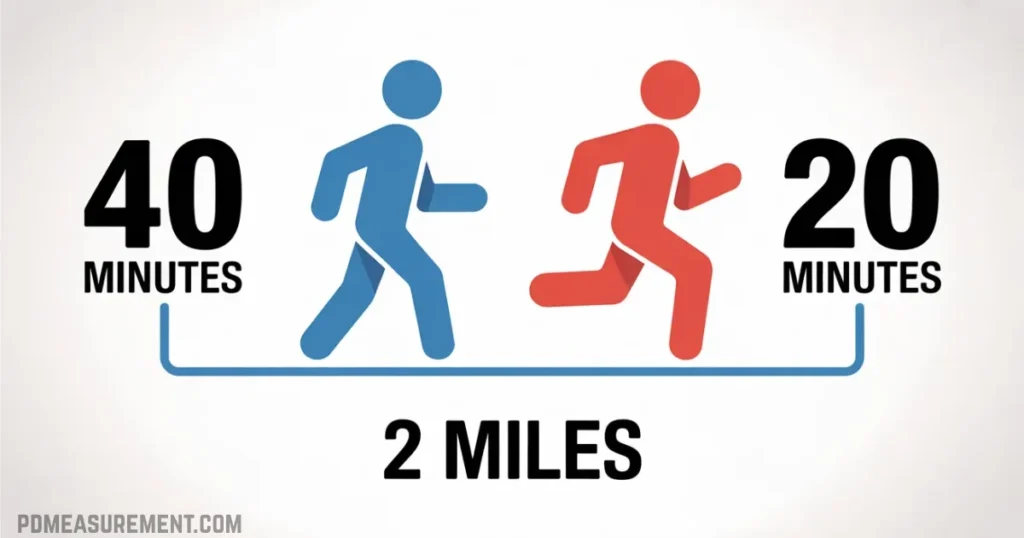
Walking and running this distance provides genuine exercise benefits. The time commitment changes dramatically based on your pace and conditioning level.
Regular walking reduces cardiovascular disease risk by 30-40%. Two miles daily represents a solid foundation for heart health.
Walking 2 Miles
Average walkers moving at 3-4 mph complete 2 miles in 30-40 minutes. This represents a comfortable, sustainable pace suitable for most adults. Your heart rate stays elevated without causing excessive fatigue.
Brisk walking at 4-5 mph cuts the time to 25-30 minutes. This faster pace burns approximately 200-300 calories depending on body weight and terrain. Many fitness trackers classify this speed as moderate-intensity exercise.
Casual strolling at 2-3 mph extends the journey to 40-50 minutes. This leisurely pace suits scenic routes, nature walks, or recovery days. The slower speed still provides health benefits while minimizing physical stress.
Terrain makes a massive difference. Uphill walking on inclines requires 50% more energy expenditure compared to flat surfaces. Trail conditions, uneven ground, and elevation changes all impact your actual completion time.
Running 2 Miles
Beginner runners typically complete 2 miles in 20-24 minutes at 5-6 mph. This pace allows for conversation while maintaining forward momentum. New runners should focus on consistency rather than speed initially.
Intermediate runners with several months of training finish in 15-18 minutes at 7-8 mph. This pace demonstrates solid cardiovascular fitness and improved running economy. Many recreational athletes maintain this speed comfortably.
Experienced runners hit 12-14 minutes at 9-10 mph. Elite athletes push even faster. The world record for 2 miles stands at 7:58.61, set by Daniel Komen in 1997.
Pacing strategy matters enormously. Starting too fast causes premature fatigue. The ideal approach involves negative splits, where your second mile matches or beats your first mile time. This technique optimizes energy distribution.
Questions
What can you compare a mile to?
A single mile equals approximately 2,000 steps for the average adult. It’s roughly 16 football fields placed end to end, or 4 laps around a standard running track.
What is an impressive 2 mile time?
For recreational runners, under 16 minutes represents solid fitness. Sub-14 minutes indicates advanced conditioning. Competitive athletes often target 12-13 minutes, while elite runners aim for under 10 minutes.
How far is 2 miles in perspective?
Two miles is the distance from the Capitol Building to the Lincoln Memorial on the National Mall. It’s also 8 complete laps on a running track, or about 40 city blocks in most urban grid systems.
What is one mile compared to?
One mile equals 1,760 yards or 5,280 feet. It’s the same as 1.6 kilometers in the metric system. Visually, it’s 4 laps around a track or approximately 15 city blocks in a standard grid layout.
How far is 2 miles when walking?
Walking 2 miles typically requires 30-40 minutes for most adults at a comfortable pace. The exact time depends on walking speed, terrain difficulty, and individual fitness level.
Conclusion
Two miles changes shape depending on how you move through it. Behind the wheel, it’s a quick 2-minute highway stretch. On foot, it becomes a 40-minute journey that tests your endurance.
Try experiencing it yourself this week. Walk it, run it, or just notice it during your daily travels. You’ll discover that 2 miles is never just a number, it’s a personal measurement of time, effort, and the pace at which you choose to move through life.
See More: 9 Everyday Things That Weigh 100 Kilograms

Hi, I’m Burhan Ali, the admin and author of PD Measurement. I write simple and clear blogs about PD measurement, measuring tools, and accurate sizing guides. My goal is to help readers understand measurements easily and make better decisions with confidence.