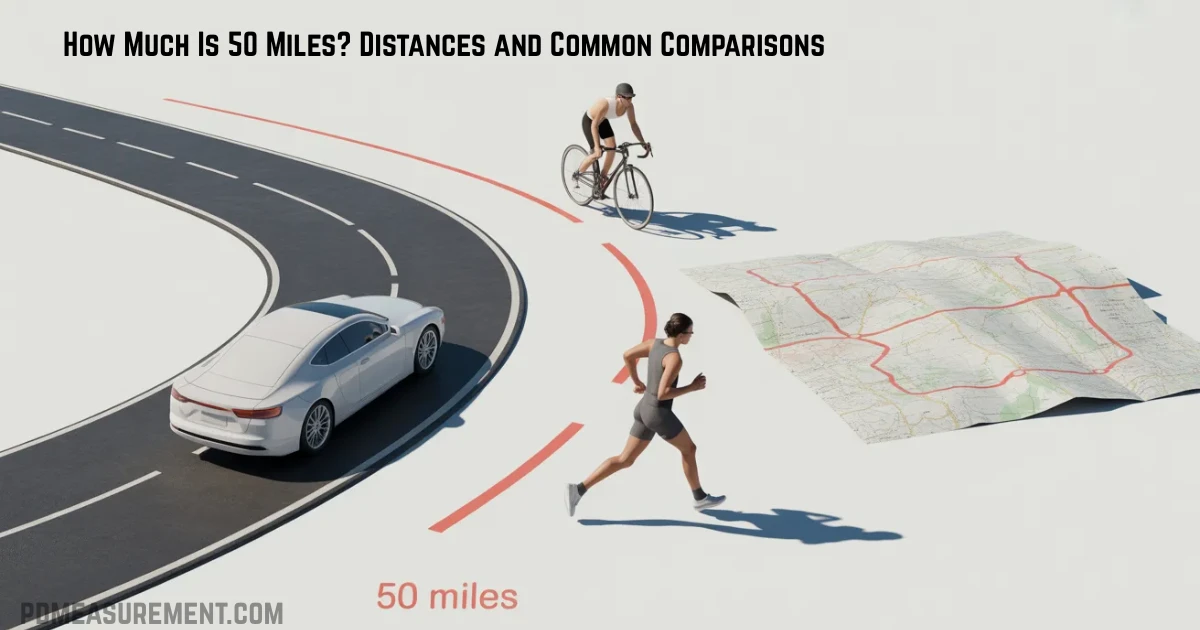
Fifty miles represents a substantial distance that transforms dramatically based on your mode of travel. This length equals 80.5 kilometers and ranges from a comfortable hour-long drive to a grueling all-day walking or running challenge.
Whether you’re commuting, training, or just curious about measurements, recognizing what 50 miles represents gives you practical perspective. Let’s explore the distances, times, and comparisons that demonstrate this significant length.
How Far Is 50 Miles?

Fifty miles equals 80.47 kilometers, 88,000 yards, or 264,000 feet. It’s a considerable distance representing cross-regional travel, challenging endurance events, or significant geographical spans.
Your daily commute might cover 10 to 20 miles round trip, so 50 miles equals roughly 2.5 to 5 times your total daily driving. This comparison helps visualize the distance through familiar routines.
This measurement appears frequently in ultramarathon races, regional travel, metropolitan area spans, and long-distance cycling. Planners use 50 miles because it represents a meaningful challenge that separates casual activities from serious endurance endeavors.
How Long Does 50 Miles Take?
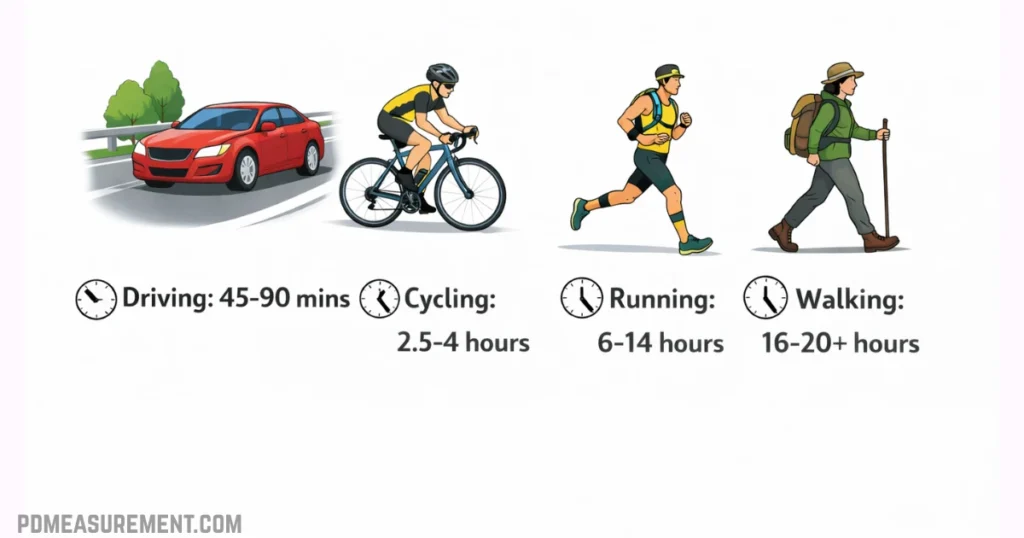
The time required to cover 50 miles varies enormously based on transportation method. From highway driving to ultramarathon running, this distance showcases how speed reshapes our relationship with space.
Driving 50 Miles
Highway driving at 60 to 65 mph covers 50 miles in 45 to 50 minutes. Interstate travel at consistent speeds makes this distance feel manageable for regular commuters.
Urban and suburban driving takes 75 to 90+ minutes due to traffic lights, congestion, and lower speed limits. Heavy city traffic can extend the journey to 1.5 hours or more.
Cycling 50 Miles
Recreational cyclists averaging 12 to 15 mph complete 50 miles in 3.5 to 4 hours. This represents a challenging day ride requiring adequate training and nutrition.
Experienced road cyclists maintaining 18 to 20 mph finish in 2.5 to 3 hours. Competitive riders treat 50 miles as moderate training distances completed regularly.
Running 50 Miles
Elite ultramarathon runners complete 50 miles in 6 to 7 hours, maintaining impressive sub-9-minute-per-mile paces over extreme distances.
Average ultramarathoners finish in 11 to 14+ hours, running at 13 to 16-minute-per-mile paces. This grueling effort requires months of specialized training and mental fortitude.
Walking 50 Miles
Continuous brisk walking at 3 mph requires approximately 16 to 17 hours to cover 50 miles. This sustained effort demands exceptional endurance and determination.
Leisurely walking at 2 to 2.5 mph extends the journey to 20+ hours, making 50-mile walks multi-day endeavors for most people. Hikers typically break this distance across several days.
Physical Effort Required for 50 Miles
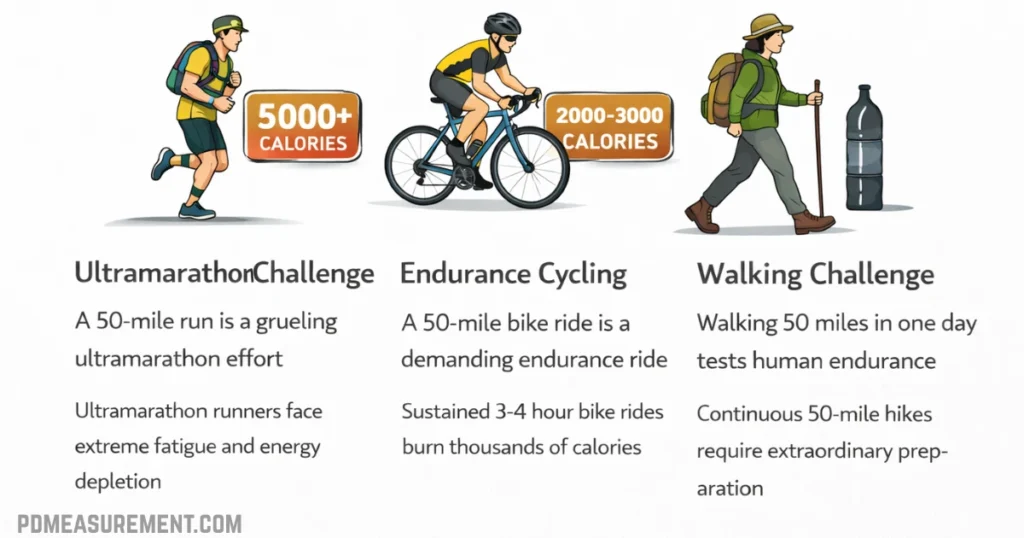
Physical demands of 50 miles helps appreciate the distance beyond simple mathematics. Your body experiences profound challenges at this length.
Ultramarathon Challenge
A 50-mile run burns approximately 5,000+ calories for average runners, creating massive energy demands. Proper fueling becomes critical for completion.
Runners experience significant muscle fatigue, blisters, and mental challenges during 50-mile efforts. The distance tests physical and psychological limits simultaneously.
50-mile races are considered “an entirely different animal” compared to 50K races (31 miles). The additional 19 miles creates exponentially greater difficulty.
Endurance Cycling
A 50-mile bike ride represents a “long ride” for recreational cyclists, requiring 3 to 4 hours of sustained effort. Proper bike fit and conditioning prevent injury.
Cyclists burn 2,000 to 3,000 calories during 50-mile rides depending on intensity. Nutrition and hydration planning becomes essential for performance.
Walking Challenge
Walking 50 miles in a single day pushes human endurance limits. While possible for conditioned individuals, it requires exceptional preparation and determination.
Military forced marches sometimes cover 50 miles, though soldiers train extensively for these extreme tests. Civilian attempts demand months of progressive training.
What 50 Miles Looks Like
Comparing 50 miles to familiar distances and locations helps contextualize the measurement practically.
City to City Distance
Fifty miles roughly equals the distance from London to Oxford in the UK, or similar intercity travel in many regions. This represents moving between major population centers.
Metropolitan area spans frequently measure 40 to 60 miles across, making 50 miles approximately the diameter of large cities. Los Angeles, Atlanta, and Dallas exemplify this scale.
State and Regional Travel
Crossing small states or traveling across large counties often involves 50-mile journeys. This distance connects rural communities to urban centers.
Regional shopping and entertainment destinations typically sit within 50-mile radii for suburban residents. The distance defines practical travel ranges for special trips.
Coastal and Natural Features
Many coastline segments measure 50 miles, creating popular scenic drives and cycling routes. California’s Highway 1 and Florida’s coastal roads feature 50-mile stretches.
National park loop roads sometimes approach 50 miles, allowing visitors to experience diverse ecosystems in day trips. These routes showcase landscape variety comprehensively.
What 50 Miles Really Looks Like
Real-world comparisons to make 50 miles (≈ 80 km) feel tangible — from commutes and races to bike rides and daily life distances.
Extreme Daily Commute
A 50-mile one-way commute is considered very long — many workers do this daily for better housing or jobs. At highway speeds (60 mph), it takes ~50 minutes each way; in traffic, often 90+ minutes. Employers often see 50 miles as the practical maximum for daily driving before relocation makes more sense.
50-Mile Ultramarathon
The 50-mile ultramarathon is a popular step up from the marathon (26.2 miles) for serious runners. Hundreds of organized ultra events worldwide use this exact distance each year. Finishing one is a major achievement — it separates casual marathoners from dedicated endurance athletes. Typical finish times range from 6–12+ hours depending on terrain and fitness.
50-Mile Recreational Cycling Route
Bike clubs and charity rides often feature 50-mile routes as an intermediate challenge — longer than a metric century (62 miles) but shorter than a full century (100 miles). At a moderate cycling pace (12–18 mph), it takes 3–5 hours. Many riders use 50 miles to build endurance before tackling longer events. Charity rides frequently choose 50 miles as a meaningful yet achievable fundraising distance.
Real-World Travel Times for 50 Miles
• Highway driving (60 mph): ~50 minutes
• City/traffic driving (40 mph average): ~1 hour 15 minutes
• Jogging (6 mph): ~8 hours 20 minutes
• Casual cycling (15 mph): ~3 hours 20 minutes
• Walking (3 mph): ~16 hours 40 minutes
These times show how 50 miles can feel like a quick drive, a full afternoon ride, or an all-day challenge depending on your mode of travel.
Why Knowing 50 Miles Matters
Knowing what 50 miles represents helps you make informed decisions about travel, training, and lifestyle choices.
Commute planning improves when you understand realistic travel times. Recognizing 50-mile drives take 45 to 90+ minutes influences job and housing decisions.
Fitness goal setting becomes more realistic with distance comprehension. 50-mile runs require 11+ hours tempers expectations appropriately.
Question’s
How long is 50 miles driving?
Fifty miles takes 45 to 50 minutes on highways at 60-65 mph, or 75 to 90+ minutes in urban traffic. Heavy congestion can extend the journey to 1.5 hours or more during rush hour.
Is 50 miles a long distance?
Yes, 50 miles is considered a long distance—it’s nearly double a marathon length, represents a significant commute requiring 45+ minutes driving, and takes 16+ hours of continuous walking. For running, it’s an extreme ultramarathon challenge.
How many miles is 2 hours by car?
Two hours of highway driving at 60-65 mph covers approximately 120 to 130 miles. In slower traffic at 30-40 mph, two hours covers about 60 to 80 miles depending on conditions.
Can a human walk 50 miles in a day?
Yes, conditioned individuals can walk 50 miles in approximately 16 to 20 hours, though it requires exceptional preparation, proper footwear, nutrition, and mental determination. Most people need extensive training to accomplish this feat.
How long does it take to do 50 miles?
Fifty miles takes 45-60 minutes driving, 2.5-4 hours cycling at 12-20 mph, 11-15+ hours running (ultramarathon), or 16-20 hours walking. Time varies dramatically based on transportation method and individual fitness.
How long is a 50 mile ride?
A 50-mile bike ride takes recreational cyclists 3 to 4 hours at 12-15 mph, or 2.5 to 3 hours for experienced riders at 18-20 mph. Mountain biking or hilly terrain extends this to 4 to 6 hours.
What is the 50 mile rule?
The “50-mile rule” typically refers to business travel deductions (IRS allows deductions for trips over 50 miles from home) or recruitment zones (companies often recruit within 50-mile radii). Context determines the specific application.
Conclusion
Fifty miles represents a substantial distance that transforms dramatically based on how you cover it. Whether driving in under an hour or running for 11+ hours, this measurement demonstrates how transportation mode fundamentally reshapes our experience of space.
Now that you understand what 50 miles means practically, you can better plan commutes, set endurance goals, and appreciate regional geography. Use these time estimates and comparisons as references when making travel decisions, training for events, or simply understanding distances in your world for smarter choices and realistic expectations.
See More: How Much Is 10 Miles? Distances That Are 10 Miles Long

Hi, I’m Burhan Ali, the admin and author of PD Measurement. I write simple and clear blogs about PD measurement, measuring tools, and accurate sizing guides. My goal is to help readers understand measurements easily and make better decisions with confidence.