US dollar bills are handled millions of times every day across the USA — yet most people have never stopped to consider their exact measurements. Whether you’re designing a wallet, building a money counter, or simply curious — knowing the precise dollar bill dimensions is more useful than you’d expect.
What Are the Dollar Bill Dimensions?
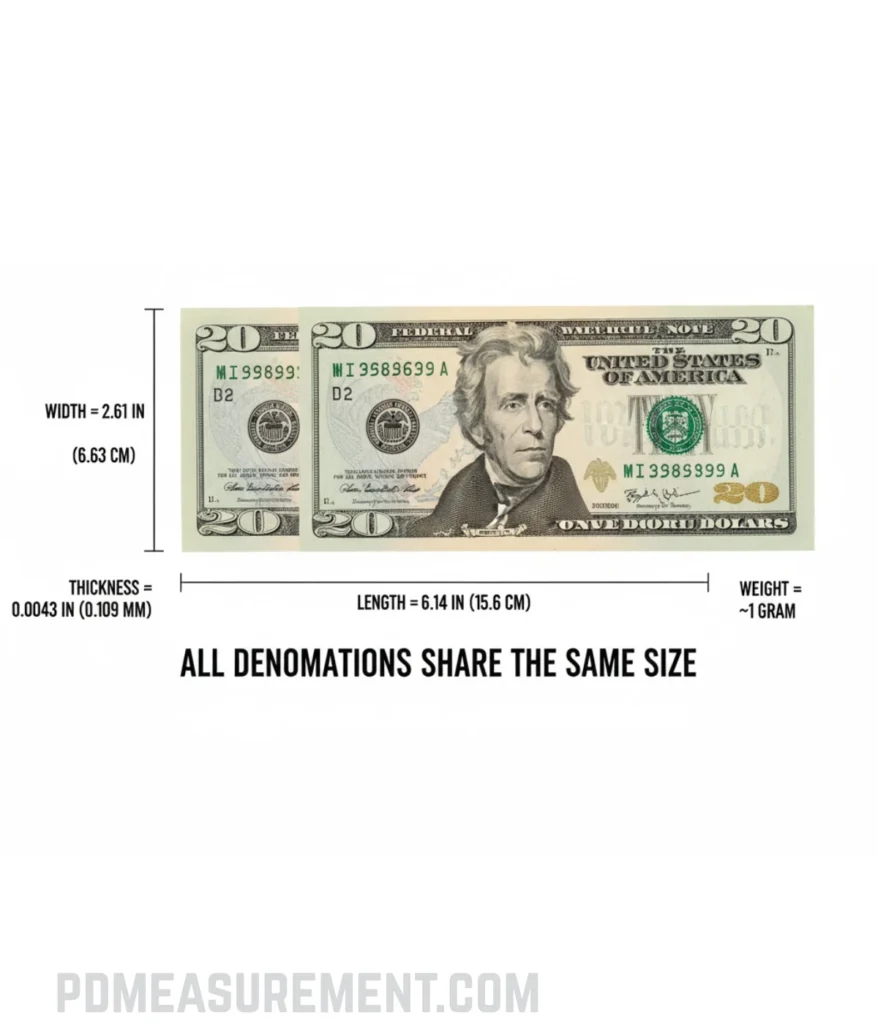
Every US paper currency note currently in circulation shares the exact same physical dimensions — regardless of denomination. A $1 bill, $20 bill, and $100 bill are all identical in size.
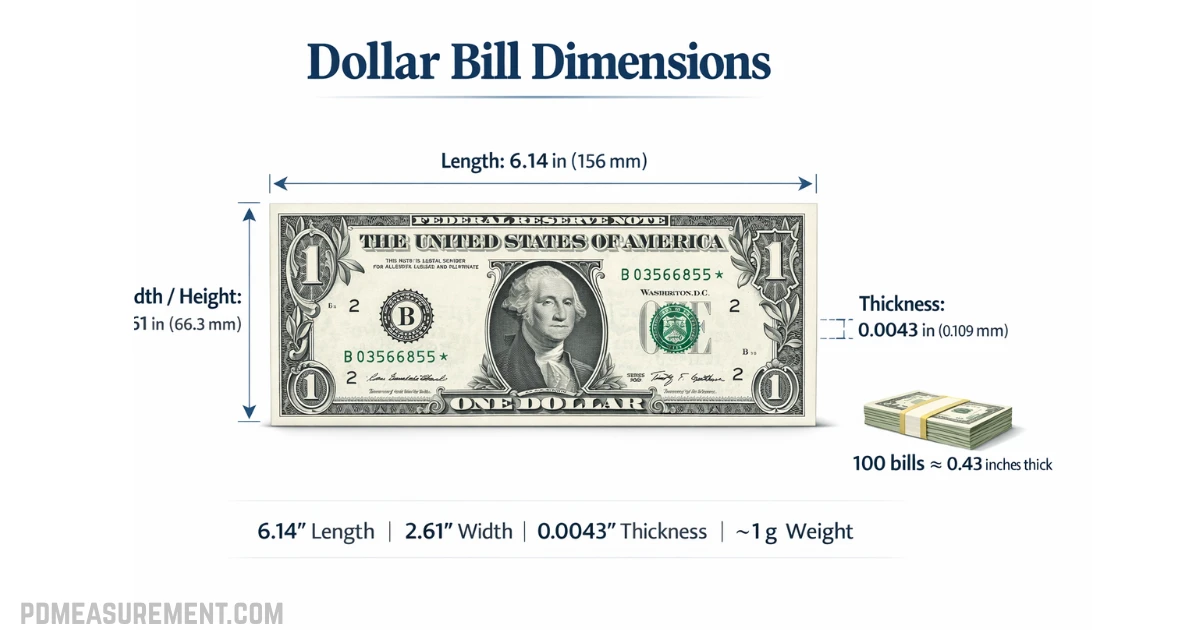
Length = 6.14 inches = 15.6 centimeters = 156 millimeters = 0.512 feet Width = 2.61 inches = 6.63 centimeters = 66.3 millimeters = 0.217 feet Thickness = 0.0043 inches = 0.109 millimeters = 0.000358 feet Weight = approximately 1 gram = 0.035 ounces
| Measurement | Inches | Centimeters | Millimeters |
|---|---|---|---|
| Length | 6.14 in | 15.6 cm | 156 mm |
| Width | 2.61 in | 6.63 cm | 66.3 mm |
| Thickness | 0.0043 in | 0.109 mm | 0.109 mm |
| Weight | — | — | ~1 gram |
How Big Is A Dollar Bill?
The standard US dollar bill is a flat rectangular note measuring 6.14 inches long and 2.61 inches wide. It is thin enough to feel almost weightless — at just 0.0043 inches thick and 1 gram in weight.
This size has been completely standardized across all US currency denominations since 1929 — meaning a $1 bill and a $100 bill are physically identical in length, width, and thickness. Only the printed design, security features, and ink differ between denominations.
Dollar Bill Height
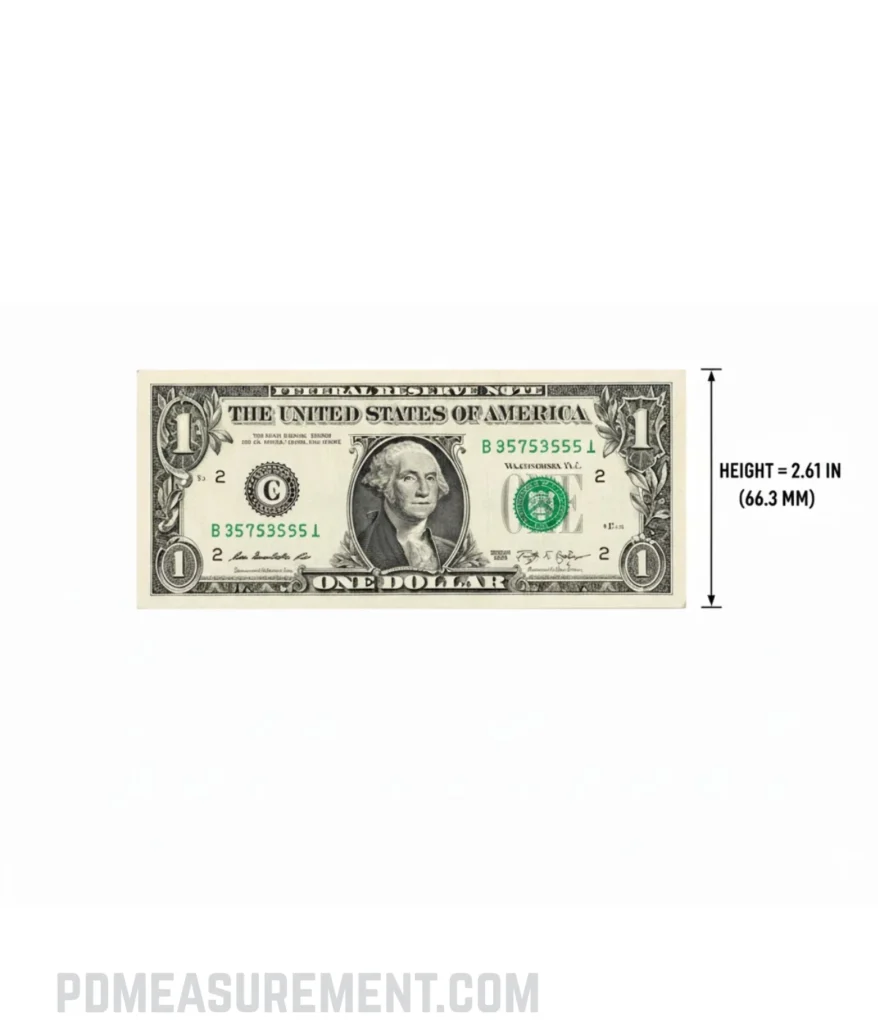
Height and width refer to the same measurement on a flat rectangular note — the shorter edge. The dollar bill height (width) is 2.61 inches (66.3 mm). This vertical dimension fits perfectly inside a standard bi-fold wallet designed for US currency, which typically measures around 3.5 inches tall to allow bills to sit with room above.
The 2.61-inch height is also why most ATM machines, cash registers, and bill counters in the USA are calibrated to this exact measurement — it is the universal US currency standard.
Dollar Bill Width
The dollar bill length is 6.14 inches (156 mm) — the longer horizontal dimension. This is close to but not exactly 6 inches — a common misconception. The precise measurement is 6.14 inches, which equals 15.6 centimeters or 156 millimeters.
This length was standardized in 1929 when the US government reduced all banknote sizes from the older large-format bills. Before 1929, US currency measured approximately 7.375 inches long by 3.125 inches wide — significantly larger than today’s notes.
Dollar Bill Thickness
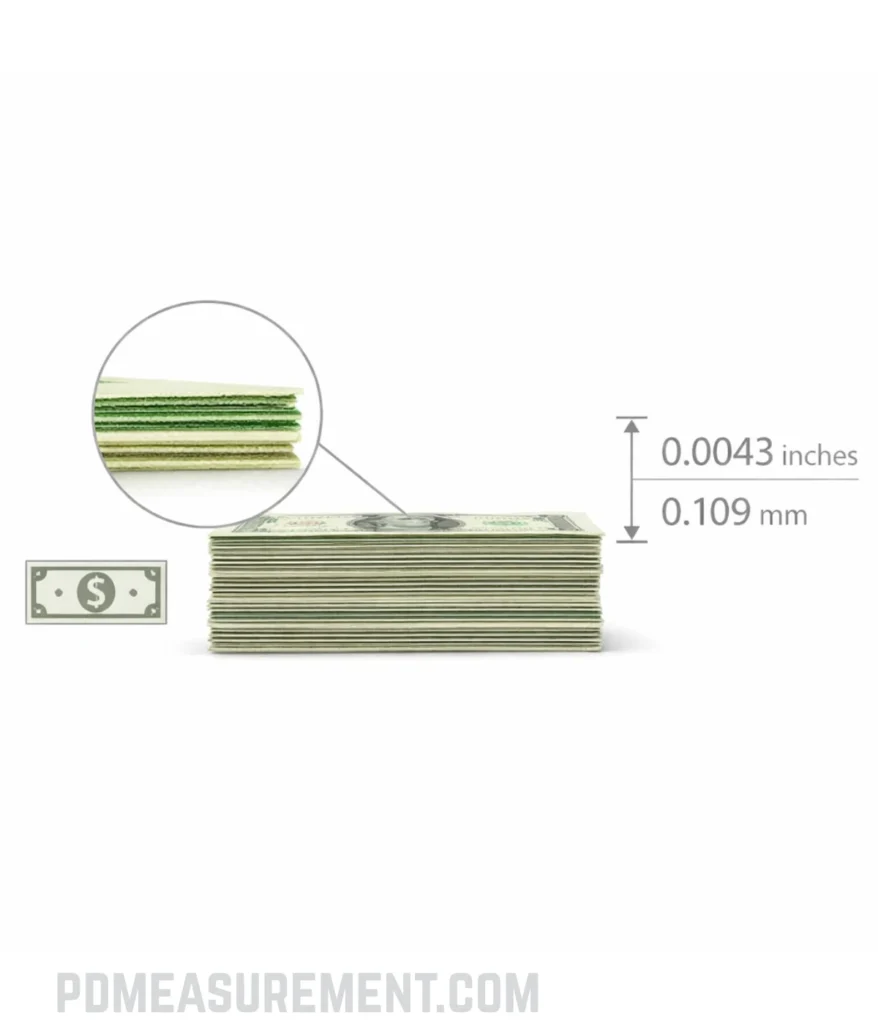
At just 0.0043 inches (0.109 mm) thick, the US dollar bill is one of the thinnest everyday objects most people regularly handle. A single bill is barely perceptible in thickness — but stack 100 bills together and the pile reaches approximately 0.43 inches (10.9 mm) thick.
A stack of 1,000 dollar bills measures approximately 4.3 inches (10.9 cm) tall. This is a useful reference for bank vault planning, cash drawer design, and ATM cassette engineering across the USA.
Dollar Bill Material and Composition
US dollar bills are not made from regular paper — this is one of the most common misconceptions about American currency. Every note is composed of 75% cotton and 25% linen — a specialized blend that gives bills their distinctive feel, durability, and resistance to tearing.
This cotton-linen blend also makes US currency significantly more durable than standard paper. The Federal Reserve estimates the average lifespan of a $1 bill is approximately 6.6 years before it is taken out of circulation — larger denominations like the $100 bill last even longer due to less frequent handling.
Dollar Bill Sizes
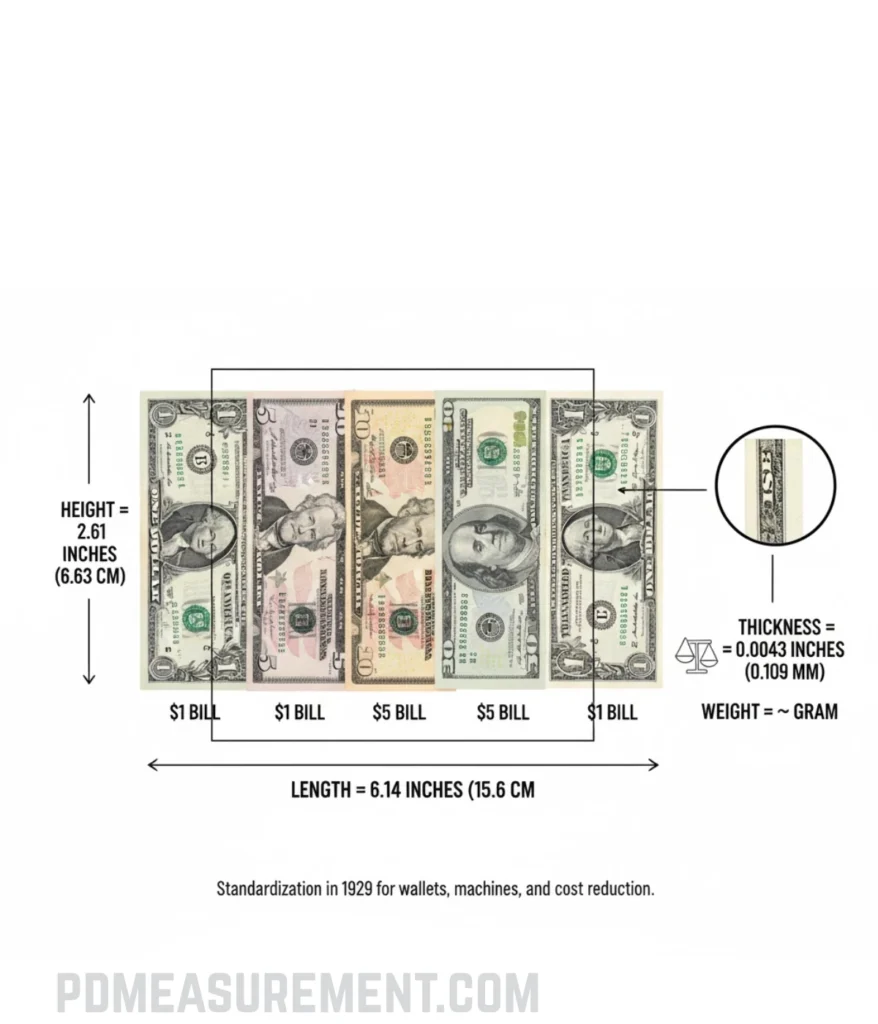
Every US currency denomination shares the exact same physical dimensions — this standardization was introduced in 1929 to reduce manufacturing costs and improve compatibility with wallets, machines, and cash-handling equipment across the USA.
| Denomination | Length | Width | Thickness | Weight |
|---|---|---|---|---|
| $1 Bill | 6.14 in | 2.61 in | 0.0043 in | 1 gram |
| $5 Bill | 6.14 in | 2.61 in | 0.0043 in | 1 gram |
| $10 Bill | 6.14 in | 2.61 in | 0.0043 in | 1 gram |
| $20 Bill | 6.14 in | 2.61 in | 0.0043 in | 1 gram |
| $50 Bill | 6.14 in | 2.61 in | 0.0043 in | 1 gram |
| $100 Bill | 6.14 in | 2.61 in | 0.0043 in | 1 gram |
Every denomination from $1 to $100 is physically identical. The only visual differences are the portrait, color-shifting ink, security thread placement, and watermark design — all part of the US Bureau of Engraving and Printing’s anti-counterfeiting measures.
Dollar Bill Dimensions vs Other Countries’ Currency
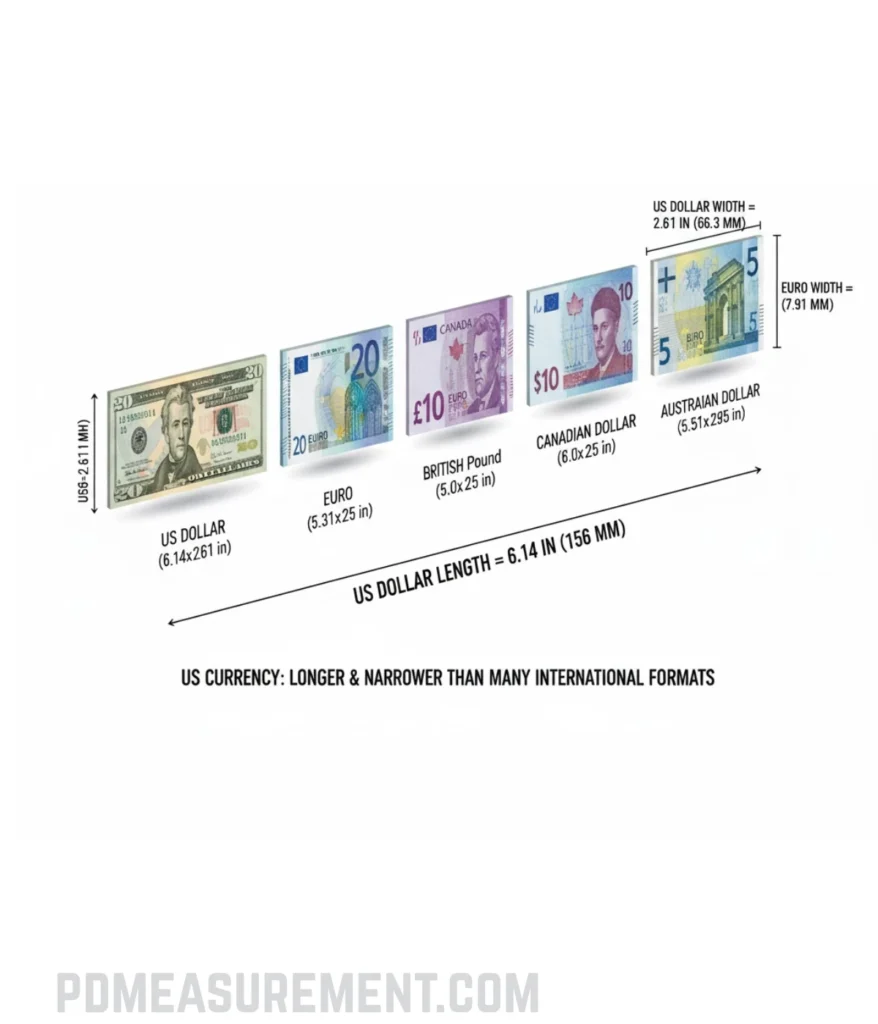
The US dollar bill is notably longer and narrower compared to many international banknote formats — a distinctive proportion that makes American currency immediately recognizable worldwide.
| Currency | Length | Width | Country |
|---|---|---|---|
| US Dollar | 6.14 in / 156 mm | 2.61 in / 66.3 mm | USA |
| Euro | 5.31 in / 134.9 mm | 2.91 in / 73.9 mm | Europe |
| British Pound (£5) | 5.0 in / 125 mm | 2.5 in / 65 mm | UK |
| Canadian Dollar | 6.02 in / 152.4 mm | 2.75 in / 69.85 mm | Canada |
| Australian Dollar | 5.51 in / 140 mm | 2.95 in / 74.8 mm | Australia |
The Euro is shorter but wider than the US dollar. The British Pound is the most compact major currency note. The Canadian dollar is the closest in length to the US dollar at 6.02 inches — but slightly wider at 2.75 inches. The Australian dollar is shorter and notably wider at 2.95 inches.
Question’s
What size are US dollar bills?
All US dollar bills measure 6.14 inches (156 mm) long and 2.61 inches (66.3 mm) wide — identical across every denomination.
Is a dollar bill exactly 6 inches?
No — a dollar bill is 6.14 inches long, not exactly 6 inches. The precise measurement is 156 millimeters or 15.6 centimeters.
What is the size of a $100 bill?
A $100 bill is identical in size to every other US denomination — 6.14 inches long, 2.61 inches wide, and 0.0043 inches thick.
How many inches is a $1 bill?
A $1 bill is 6.14 inches (15.6 cm) long and 2.61 inches (6.63 cm) wide.
What can I use instead of a ruler?
A US dollar bill makes an excellent informal measuring tool — at 6.14 inches long and 2.61 inches wide, it can estimate lengths with reasonable accuracy in everyday situations.
How tall is a US dollar bill?
The height (shorter edge) of a US dollar bill is 2.61 inches (66.3 mm) — this is the standard dimension that fits inside bi-fold wallets and cash register drawers across the USA.
What are the dimensions of a US dollar bill?
A US dollar bill measures 6.14 inches long, 2.61 inches wide, and 0.0043 inches thick — weighing approximately 1 gram.
Conclusion
The standard dollar bill dimensions are 6.14 inches long, 2.61 inches wide, and 0.0043 inches thick — weighing just 1 gram and composed of 75% cotton and 25% linen. This size has remained unchanged since 1929, making it one of the most consistent everyday objects in American life.
From $1 to $100, every US currency denomination shares these exact measurements — a standardization that keeps wallets, ATMs, cash registers, and bill counters across the USA perfectly calibrated for over nine decades.

Hi, I’m Burhan Ali, the admin and author of PD Measurement. I write simple and clear blogs about PD measurement, measuring tools, and accurate sizing guides. My goal is to help readers understand measurements easily and make better decisions with confidence.