One hundred feet represents a significant measurement that defines large structures and impressive distances. This length equals approximately a school bus or one-third of a football field.
Whether you’re assessing construction projects, recognizing common 100-foot structures gives you an instant reference point. Let’s explore the buildings, vehicles, and natural objects that perfectly demonstrate this substantial measurement.
How Long Is 100 Feet?
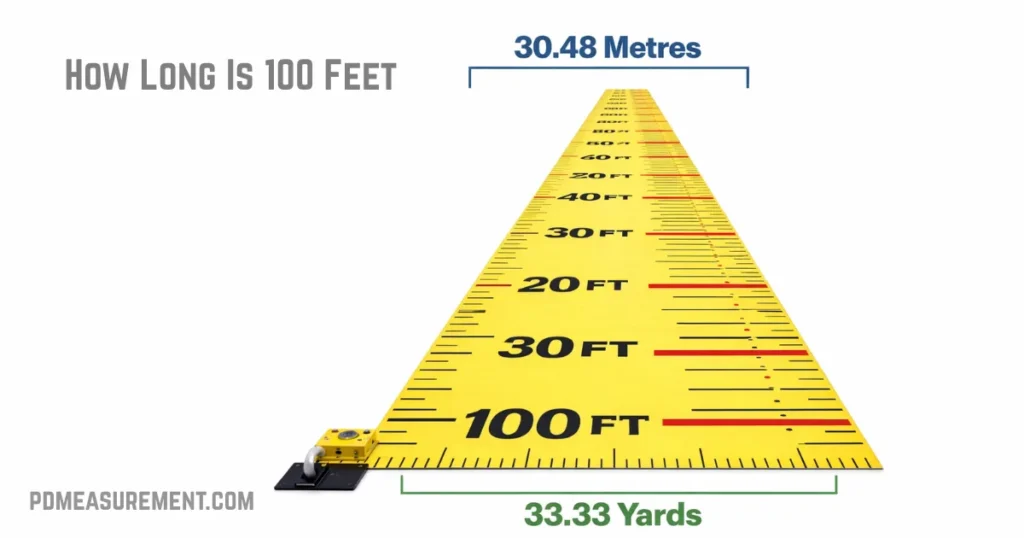
One hundred feet equals 30.48 meters or 33.33 yards. It’s 1,200 inches total or approximately the height of a 10-story building. This impressive distance appears constantly in construction, sports, and urban planning.
Your average adult measures about 5.5 feet tall, so roughly 18 people lying head-to-toe equal 100 feet. Walking 100 feet takes approximately 33 to 40 seconds at normal pace, making it a noticeable but manageable distance.
Things That Measure 100 Feet In Length
These impressive structures and objects demonstrate exactly how long 100 feet is in real life. From architecture to nature, this measurement defines substantial proportions.
Standard School Bus (Plus Small Car)

A full-size school bus measures approximately 35 to 40 feet long. Adding a compact car (10 to 15 feet) to the end creates roughly 50 feet. Two school buses end-to-end equal 70 to 80 feet, approaching 100 feet closely.
Transportation planners use school bus dimensions for parking lot design. Visualizing 2.5 buses demonstrates 100 feet in familiar vehicular terms.
One-Third of a Football Field

An American football field measures 300 feet from goal line to goal line (excluding end zones). One-third of this distance equals exactly 100 feet. This sports reference works perfectly for athletics fans.
Football players and coaches understand field dimensions intimately. Visualizing from the goal line to the 33-yard line equals 100 feet precisely.
Ten-Story Building

Commercial buildings measure approximately 10 feet per story, making a ten-story structure about 100 feet tall. Office buildings and apartment complexes frequently use this height in urban areas.
City residents see ten-story buildings throughout downtown districts. The vertical measurement demonstrates 100 feet in architectural context worldwide.
Seven Average Cars (End-to-End)

Standard sedans measure approximately 14 to 16 feet long, so six to seven cars parked bumper-to-bumper equal roughly 100 feet. This parking lot visualization works perfectly for horizontal estimation.
Drivers encounter parked cars constantly in lots and streets. Visualizing seven vehicles creates immediate understanding of 100-foot distances.
Standard Bowling Lane (With Approach)

Regulation bowling lanes measure 60 feet from foul line to headpin, and including the 15-foot approach area behind the foul line creates approximately 75 feet total. Adding ball return space reaches close to 100 feet.
Bowling alleys worldwide maintain these dimensions. The familiar lane length plus surrounding space provides recreational context for 100-foot measurements.
Basketball Court (Slightly Longer)

A regulation basketball court measures 94 feet long, making it just 6 feet short of 100 feet. This sports facility appears in schools, gyms, and professional arenas globally.
Basketball players recognize court dimensions from thousands of practice hours. Adding a few feet mentally to full court length equals 100 feet accurately.
Mature Oak or Pine Tree

Large oak and pine trees commonly reach 80 to 120 feet tall when fully mature. Many specimens measure very close to 100 feet, providing natural vertical references.
Arborists and nature enthusiasts identify century-old trees approaching this height. The impressive natural monuments demonstrate 100 feet in forest settings.
Semi-Truck and Full Trailer

Semi-truck tractors measure 20 to 25 feet, and standard trailers add 48 to 53 feet. Combined, the rig measures approximately 70 to 78 feet. Longer combination vehicles approach 100 feet total.
Highway travelers see semi-trucks constantly on interstates. The massive vehicles help visualize large-scale 100-foot measurements.
Three-Lane Swimming Pool (Length)

Olympic-size pools measure 50 meters (164 feet) long, making 100 feet roughly 60% of an Olympic pool. Many recreational pools measure exactly 25 yards (75 feet) or 30 meters (approximately 100 feet) for lap swimming.
Competitive swimmers train in pools around this length. The aquatic reference demonstrates 100 feet horizontally in athletic facilities.
Fire Truck with Ladder Extended

Fire trucks with aerial ladders extend 75 to 100 feet when fully deployed. These emergency vehicles use the measurement for reaching upper floors of buildings during rescues.
Firefighters train with ladder extensions at maximum height. The 100-foot extension represents common operational reach for urban fire departments.
Five Standard RVs (End-to-End)

Class C motorhomes average 20 to 25 feet long, so four to five RVs parked bumper-to-bumper equal approximately 100 feet. Campgrounds demonstrate this measurement across multiple camping sites.
RV enthusiasts recognize how five average motorhomes occupy substantial campground space. The recreational vehicle reference makes 100 feet relatable for travelers.
Tennis Court (Three Times Length)

A tennis court measures 78 feet long for singles play, making 100 feet slightly longer than one full court. Visualizing one court plus a bit more demonstrates the measurement in sports contexts.
Tennis players understand court dimensions from regular play. Adding 22 feet mentally to full court length equals 100 feet accurately.
Large Yacht or Small Ship

Luxury yachts commonly measure 80 to 120 feet long, with 100 feet representing serious ocean-going vessels. These boats require professional crews and marina infrastructure.
Marinas accommodate 100-foot yachts in premium slips reserved for wealthy owners. The impressive length represents significant maritime capability and investment.
18 Adults (Head-to-Toe)

The average adult measures 5.5 to 6 feet tall, so approximately 16 to 18 people lying head-to-toe equal 100 feet. This human chain visualization works anywhere for demonstrations.
Group measurements occasionally create visual demonstrations. The 18-person reference makes 100 feet tangible in human-scale terms.
Small Apartment Building

Low-rise apartment buildings measuring 30 to 100 feet wide provide residential housing in urban areas. The building footprint demonstrates 100 feet in horizontal architectural perspective.
City planners design apartment complexes using 100-foot lot dimensions. The familiar residential structures appear throughout metropolitan neighborhoods.
100 Feet Without Measuring
Familiar references to instantly visualize 100 feet (about the height of a 10-story building or the length of seven cars).
Ten-Story Building Height
Most modern buildings have floors about 10 feet high (including floor/ceiling thickness). Look up at a 10-story building from street level — that’s roughly 100 feet tall.
One-Third of a Football Field
A football field (goal line to goal line) is 300 feet. Imagine going from the goal line to the 33-yard line — that’s exactly one-third or 100 feet. Great for sports fans.
Seven Standard Cars Bumper-to-Bumper
A typical sedan is about 14–15 feet long. Picture seven cars parked end-to-end in a parking lot — that’s very close to 100 feet.
33–40 Seconds of Normal Walking
At an average walking pace (~3 feet per second), walking straight for 33–40 seconds covers roughly 100 feet — a quick physical way to experience the distance.
100 Feet Matters in Everyday Life
Construction planning improves when estimating building heights and lot dimensions. 100 feet helps with zoning compliance and project feasibility assessments.
Safety awareness increases when recognizing recommended clearance distances. Fire codes, utility line setbacks, and emergency access often reference 100-foot measurements.
Property evaluation becomes clearer when real estate listings mention lot dimensions. 100 feet helps assess yard sizes and development potential accurately.
Sports appreciation deepens when understanding field and court dimensions. Watching games becomes more engaging when you grasp actual distances athletes cover.
Question’s
How many car lengths is 100 feet?
One hundred feet equals approximately 6 to 7 car lengths depending on vehicle size. Compact cars at 12 to 14 feet equal about 7 to 8 vehicles, while mid-size sedans at 15 to 16 feet equal roughly 6 to 7 cars end-to-end.
How much is 100 feet visually?
One hundred feet visually equals a ten-story building height, seven cars parked end-to-end, or one-third of a football field. It’s also roughly the height of mature oak trees or the length of a bowling alley including approach areas.
How to measure 100 feet?
Use a 100-foot tape measure for precise measurement, or use surveying equipment with laser distance finders. For estimation, count ten 10-foot increments, visualize seven car lengths, or pace approximately 33 to 40 steps at normal stride.
How many stories high is 100 feet?
One hundred feet equals approximately 10 stories in a commercial building assuming each floor measures about 10 feet including ceiling height and floor thickness. Residential buildings with 9-foot ceilings would have about 11 stories in this height.
Conclusion
One hundred feet appears in ten-story buildings, football fields, mature trees, bowling alleys, and large yachts throughout urban and natural environments. This substantial measurement equals seven cars end-to-end or 18 adults lying head-to-toe.
Now that you recognize common things that are 100 feet in length, you can quickly estimate building heights, athletic distances, property dimensions, and safety clearances. Use these familiar references when assessing large-scale projects or understanding impressive architectural and natural structures.
See More: 13 Things That Measure 25 Feet Long or Are Big

Hi, I’m Burhan Ali, the admin and author of PD Measurement. I write simple and clear blogs about PD measurement, measuring tools, and accurate sizing guides. My goal is to help readers understand measurements easily and make better decisions with confidence.